
When readers meet Jack Ryan Jr. in the opening pages of Tom Clancy Pressure Depth, he’s suspended 180 feet below the surface of Chuuk Lagoon, finning through the rusted holds of the San Francisco Maru. Ostensibly, he’s there to log bottom time on deep wrecks ahead of a forensic insurance survey. In reality, he’s running away.
Table of Contents

The defining personal catalyst of Pressure Depth is an emotional collapse: Lisanne Robertson has called off their engagement.
Throughout Pressure Depth, author Jack Stewart uses the physical weight of the Pacific to mirror Jack Jr.’s mental state. As Jack descends into saturation diving, claustrophobic chambers, and sudden gun battles across Guam, his character arc grapples with a fundamental identity crisis. He must confront whether a Ryan can ever truly reconcile devotion to family with an addiction to covert duty.
The Ghost of Ram Shakur
The dissolution of Jack and Lisanne’s relationship is not treated as background texture. It actively impairs Jack’s internal equilibrium. In previous books, Lisanne was the rare partner who understood the reality of Hendley Associates. She was an operator herself, someone who didn’t need Jack to fabricate cover stories about his venture capital work.
Yet, as Jack admits to himself during an encrypted video call with John Clark, Lisanne’s central accusation rang entirely true. Jack kept pushing off setting a date for their wedding, perpetually prioritizing white-side corporate audits or black-side Campus operations. Even when Clark needles him about expensing a tropical diving trip, Jack bristles at the word vacation, an internal defense mechanism designed to rebrand his escapism as professional obligation.
This emotional hangover manifests in quiet, uncomfortable moments throughout the Guam deployment.
When Jack first attempts to recruit Navy Master Diver Carla Bennett at Ladda’s Lounge, his approach is uncharacteristically clumsy. He acknowledges that the breakup has dented his confidence, leaving him hesitant and defensive when interacting outside the sterile boundaries of tactical missions.
Inside his room at the Westin on Tumon Bay, when he offers Carla a miniature bottle of single malt Scotch, Jack’s memory flashes unbidden to the Phula Mahila cottage at Ram Shakur. The simple presence of another woman in his room triggers an immediate, visceral twinge of guilt, proving how tightly the ghost of his relationship with Lisanne still holds him.
The Marrying Kind: Escaping the Parental Shadow
Hovering over Jack’s heartbreak throughout Pressure Depth is the towering standard set by Jack Ryan Sr. and his mother, Dr. Caroline Ryan. Jack Jr. grew up witnessing a marriage forged through terrorist attacks, political assassinations, and the crushing pressure of the Oval Office. He carries an innate desire to replicate that bedrock stability in his own life.
In Pressure Depth, however, Jack begins to accept a bitter reality: he may not be cut from the exact same cloth as his father.
Walking the corridors of the Westin, Jack reflects that if he were ever to achieve the kind of marriage his parents shared, it could only have happened with a woman like Lisanne. She knew the secret world. She didn’t require explanations. Yet even with a partner who shared that clandestine life, Jack’s internal sense of duty consistently dragged him away.
This realization forces Jack to confront the possibility that his bachelorhood isn’t an accident of timing, but a consequence of his nature. Jack Sr. was an academic and an analyst who went operational in moments of necessity. Jack Jr. sought out the field, badgering Gerry Hendley into giving him a job after college and deliberately pursuing the operational sharp end. In Pressure Depth, Jack begins to realize that the thrill of the mission and the pull of the team might leave no room for a domestic center.
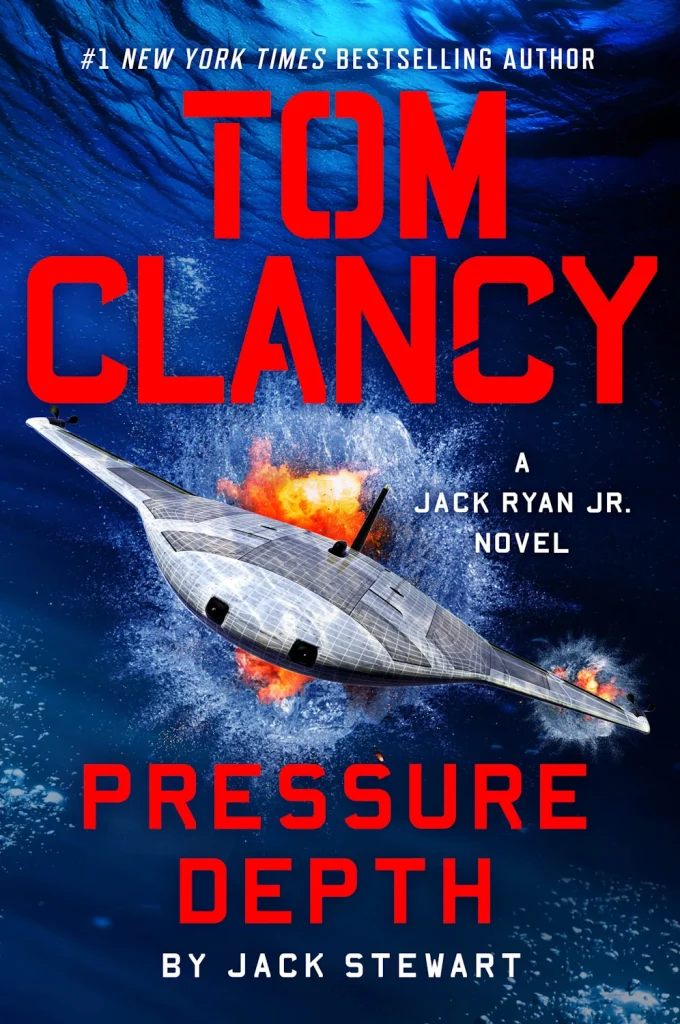
Diving as Therapy: Competence Over Combat
For much of his run in the Ryanverse, Jack Jr. has operated largely as a standard land-based intelligence operative In Pressure Depth, Stewart expands Jack’s skill set into a far more demanding discipline: technical saturation diving.
Diving serves as Jack’s coping mechanism. Beneath the surface, the noisy complexities of his personal life are stripped down to rigid mathematical rules of Bühlmann decompression, and partial pressures of oxygen, and nitrogen saturation gradient factors. Under hundreds of feet of water, a failure of discipline means ruptured lungs or boiling blood.
When Jack climbs into the hyperbaric chamber on the Pacific Resolve alongside Carla Bennett, Danny Reyes, and Chris Perry, he willingly enters a space of extreme physical confinement. Living at nineteen atmospheres, with helium-distorted vocals, and facing an environment where a minor system fault could cause explosive decompression, Jack finds a strange peace. The deep ocean demands complete presence, offering him an escape from the regrets waiting for him on dry land.
From Impulsive Operative to Measured Veteran
Despite his emotional distraction, Pressure Depth highlights a maturing operative. The brash kid who used to dive headfirst into trouble without thinking has evolved into a tactician who understands operational friction.
When an ambush unfolds along Route 1 on Guam, Jack doesn’t panic or look to play the hero. He coordinates with Kendrick Moore to draw the hit team away from the civilian convoy, integrates smoothly with Green Beret snipers Cary Marks and Jad Mustafa at the solar substation, and manages his limited ammunition methodically. Later, when Carla’s room is ransacked and Doug Park is taken hostage, Jack immediately spots the trap, analyzes the floor layout, and makes the calculated call to clear their primary extraction route rather than getting bogged down in an ego duel.
Most telling is his relationship with Carla Bennett. Where a younger Jack Ryan Jr. might have pushed to establish authority or flirted his way past her initial hostility, in Pressure Depth he defers to her technical expertise. He respects her rank, backs her play in the water, and accepts her judgment on undersea warfare systems without resentment. Jack Stewart has made the right move to steer him away from Bond-like romantic attachments in each book.
A New Chapter for Junior
Jack Ryan Jr. doesn’t finish Pressure Depth healed or magically ready for a new romance. Instead, the novel leaves him more clear-eyed about who he is.
By pushing through the loss of Lisanne Robertson, Jack accepts that the life of a Campus operator carries inescapable trade-offs. He cannot pretend to live a conventional life while answering midnight calls from Mary Pat Foley and descending into undersea abyss zones to hunt down abandoned nuclear networks. Jack Stewart presents an older, bruised, and far more self-aware protagonist: a man who has traded domestic comfort for the silent, unforgiving deep.
Final Thoughts
In my Q&A with Jack Stewart, he touched a lot on the development of Jack Jr. and the character’s direction of travel. An incredible amount of thought has gone into his development.
Personally, I’ve struggled a lot with the character over the years because he’s oftentimes seemed so counter to his father, in that he’s been rather adolescent-like. I don’t doubt his patriotism but he’s never served and lacks the mature structural framework that this might have otherwise given him — as we see with other family members and almost all Campus operators.
What I’ve seen so far of Jack, as written by Stewart, leads me to believe he’s turning a corner and that we’ll see him finally carving out his own mature niche — not looking to be his father, nor looking to be an operator of the Clark/Chavez variety.
The future of Jack Jr. is very exciting.


Leave a Reply