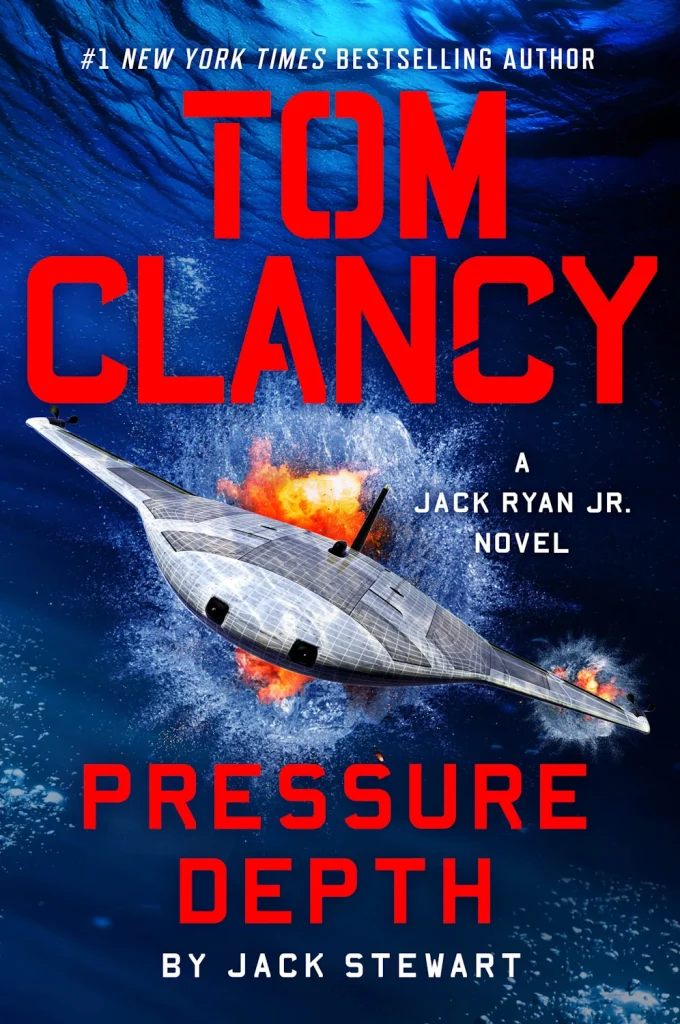
In Tom Clancy Pressure Depth, a routine maritime insurance inquiry unravels when Jack Ryan Jr. and Campus operators discover a submerged Cold War relic off the coast of Guam. Code-named Sirena by the Soviet Union, the installation features five modified five-megaton R-7 intercontinental ballistic missile warheads arrayed along the Mariana Trench. Anchored to the seabed, the system was designed to trigger an artificial tsunami capable of wiping out American naval infrastructure across Guam and Hawaii.
Table of Contents

When John Clark and Ding Chavez interrogate retired KGB Colonel Alexei Morozov (code-named ARCHER) in Washington State, Morozov points out that Soviet physicists did not invent this concept out of thin air. Instead, Sirena represented the culmination of decades of actual, classified research into tectonic warfare, drawing directly from a forgotten World War II initiative called Project Seal and the early thermonuclear theories of Andrei Sakharov.
Project Seal: The World War II Genesis of the “Tsunami Bomb”
The quest to build an artificial tidal wave began in the South Pacific in 1944. During the height of the Pacific War, Commander E. A. Gibson of the United States Navy observed civilian and military blasting operations clearing coral reefs for amphibious landings. Gibson noticed that specific arrangements of underwater detonations generated disproportionately large, focused surges of water.
Gibson passed his observations to General Sir Edward Puttick, Chief of the New Zealand General Staff. Intrigued by the offensive possibilities, Puttick briefed the New Zealand War Cabinet, which in turn coordinated with Admiral William “Bull” Halsey, commander of the US South Pacific Area. Halsey saw immense potential in the concept, noting in military correspondence that using water inundation to swamp Japanese island fortresses, breach seawalls, and shatter coastal defenses could alter amphibious warfare.
The resulting top-secret program was christened Project Seal. Established in May 1944 on the Whangaparaoa Peninsula near Auckland, New Zealand, the operation fell under the scientific direction of Professor Thomas Leech, Dean of Engineering at Auckland University College.
Between June 1944 and January 1945, Leech’s team conducted roughly 3,700 test explosions off the Whangaparaoa coast and Noumea in New Caledonia. Using TNT, nitro-starch, and gelignite charges ranging from a few grams to nearly 300 kilograms, the researchers sought the precise formula to turn ocean displacement into a directed wall of water.
The findings of Project Seal, formally documented in a final report in 1950 and declassified in 1999, reached several conclusions that directly inform the technical dialogue in Pressure Depth:
- The Failure of Single Detonations: Leech proved that a single explosive charge, regardless of size within conventional chemical limits, could not generate a functional tsunami. The energy merely created a localized water column that collapsed back into itself, generating ordinary surface chop that dissipated over short distances.
- Detonation Depth: Early British assumptions suggested deep-sea charges would produce the most violent gas bubbles. Project Seal proved the opposite: charges placed near the surface or along precise shallow-water gradients generated far more lateral wave momentum.
- The Detonation Train: The project’s central breakthrough was that wave generation required a synchronized linear array. Leech calculated that a line of approximately 4.4 million pounds (two million kilograms) of explosives, spaced across an eight-kilometer line roughly eight kilometers offshore, could create a cumulative wave front measuring thirty to forty feet in height when it reached shore.
Ultimately, Project Seal was overtaken by the Manhattan Project. In mid-1945, the atomic bomb provided devastating destructive force without the logistical nightmare of laying millions of pounds of submerged explosives along enemy coastlines under combat conditions.
Andrei Sakharov and the Megaton-Scale T-15 Torpedo
When the thermonuclear era began in the early 1950s, Soviet weapons designers revisited the wave-generation concept through an entirely different lens: raw, uninhibited nuclear yield.
During the development of the Soviet hydrogen bomb at the secret installation Arzamas-16, legendary theoretical physicist Andrei Sakharov conceived a radical application for mega-yield thermonuclear weapons. Rather than relying solely on high-altitude atmospheric blasts to devastate land-based infrastructure, Sakharov envisioned targeting coastal naval bases and ports from beneath the sea.
This concept crystallized as the T-15 nuclear torpedo. Measuring roughly twenty-four meters in length and 1.5 meters in diameter, the forty-ton weapon was so massive that the Soviet Union designed its very first nuclear-powered submarine, Project 627 (designated the November-class by NATO), entirely around housing a single forward launch tube for it.
Sakharov’s proposal called for arming the T-15 with a 100-megaton thermonuclear warhead. The tactical objective was simple: the submarine would navigate within fifty kilometers of a major American port (such as New York, Norfolk, or San Francisco) and detonate the weapon inside the harbor approaches. The blast would vaporize millions of tons of seawater, driving a massive, highly radioactive storm surge into the city while poisoning the shoreline with lethal isotopes for generations.
The T-15 project was killed before deployment, but not because of American countermeasures. Instead, Soviet naval leadership revolted against the idea. When Sakharov briefed Rear Admiral Pyotr Fomichev on the system, the admiral expressed deep revulsion, arguing that regular naval officers fought enemy combatants on the open sea rather than drowning civilian port populations in radioactive sludge.
Beyond moral reservations, the operational drawbacks were severe. The Project 627 submarine lost all conventional torpedo capability to house the single T-15 tube, and navigating an eighty-foot torpedo through shallow waters into a defended harbor was tactically unrealistic. The Soviet Navy cancelled the T-15 in 1954, pivoting instead to smaller, tactical torpedoes like the T-5. Sakharov himself later became a vocal dissident, expressing regret over his early work on such indiscriminate weapons.
The Physics of Underwater Nuclear Detonations and Why “Tsunami Weapons” Fail
The operational rationale behind abandoning these systems in the real world centers on fluid dynamics, bathymetry, and energy dissipation. The United States gained firsthand empirical data on underwater nuclear blasts during Operation Crossroads in July 1946 with the “Baker” test, which detonated a 21-kiloton weapon twenty-seven meters below the surface of Bikini Atoll.
The Baker test proved that underwater nuclear detonations exhibit distinct physical characteristics:
- The Plume and the Wilson Cloud: The immense heat and pressure instantly create a high-pressure gas bubble that punches through the surface, lifting millions of tons of water into a hollow cylinder over a kilometer tall.
- The Base Surge: As the massive water plume collapses back into the sea, it forms a dense, aerosolized mist of radioactive spray that sweeps radially across the water surface, coating nearby vessels in lethal levels of radiation.
- Wave Generation versus Dissipation: While the Baker blast generated initial waves roughly ninety feet high within three hundred meters of ground zero, those waves decayed exponentially as they radiated outward. At a distance of three miles, the wave height had diminished to less than fifteen feet.
True tsunamis, such as those caused by subsea earthquakes or massive submarine landslides, are long-period waves. They involve the vertical displacement of entire ocean columns across hundreds of square miles, giving them wavelengths measured in tens or hundreds of kilometers. These long-wavelength waves carry enormous energy across entire oceans with minimal dissipation.
In contrast, a point-source explosion, even one measured in megatons, creates short-period, high-frequency waves. Because their wavelengths are short, the waves disperse their energy rapidly against each other and the surrounding water column through turbulence, whitecapping, and sea-floor friction before reaching distant coastlines.
How Pressure Depth Bridges History and Fiction
In Pressure Depth, Jack Stewart solves the physical limitations of point-source detonations by synthesizing Project Seal’s mechanics with Sakharov’s thermonuclear scale.
Rather than relying on a single mega-yield blast like the T-15, the fictional Sirena project adapts Professor Leech’s discovery: wave generation requires a distributed array. By linking five five-megaton R-7 ICBM warheads across kilometers of subsea cabling along the trench wall, the installation was configured to fire in a calculated sequence. The objective was to artificially trigger a structural collapse of the trench slope, using thermonuclear energy to force a massive underwater landslide. That mass displacement, rather than the explosive bubbles alone, would create the long-period tectonic wave necessary to threaten Guam and Hawaii.
Pressure Depth also mirrors real-world Cold War politics through the legendary Soviet naval architect Admiral Sergey Gorshkov. Just as Gorshkov built the modern blue-water Soviet Navy on discipline and flexible power projection, the story notes that Gorshkov recognized Sirena’s fatal flaw: directional unpredictability. An artificial seabed collapse in the Mariana Trench offered zero targeting precision. It posed just as severe a hazard to Soviet maritime traffic and Vladivostok-based naval fleets as it did to Western targets, ultimately prompting Moscow to cut the funding and bury the operational records.
By grounding Sirena in the actual field notebooks of Project Seal and the extreme conceptual designs of the early Soviet hydrogen bomb program, Pressure Depth elevates its plot above generic villainy, delivering a believable look at the destructive boundaries of twentieth-century military science.
Pressure Depth is Jack Stewart’s debut novel in the Ryanverse and the Jack Ryan Jr. Thriller We’ve Been Waiting For.


Leave a Reply